ABA therapy communication skills autism Virginia families prioritize are consistently among the most important treatment targets in any ABA program — and for good reason. Communication ability is the single factor most directly connected to independence, quality of life, and behavioral outcomes across the lifespan for individuals with autism spectrum disorder. The relationship between limited communication and challenging behavior is well-established and direct: individuals who cannot reliably communicate their needs, wants, and discomfort rely on whatever behavior has historically produced the outcomes communication would achieve — which often means behaviors that are difficult for families and caregivers to manage and that limit the individual’s access to the environments and relationships they deserve.
Why Communication Is the Foundation of ABA Treatment
Applied behavior analysis approaches communication not as a separate therapeutic domain but as the foundation that every other area of the treatment program builds on. A child who develops reliable functional communication — the ability to request preferred items and activities, to refuse non-preferred ones, to comment on the environment, to ask for help, and to engage in reciprocal social exchange — is a child whose behavioral profile changes substantially as communication ability grows.
The mechanism is straightforward: challenging behaviors that were previously serving a communicative function — getting something, getting out of something, getting attention, or providing sensory input — become less necessary as the individual develops more efficient and more socially appropriate ways to achieve those same outcomes. This is why communication skill development in ABA therapy isn’t just about teaching language — it’s about changing the behavioral landscape by giving the individual tools that work better than the challenging behaviors that were previously filling the same function.

The Range of Communication Goals in ABA
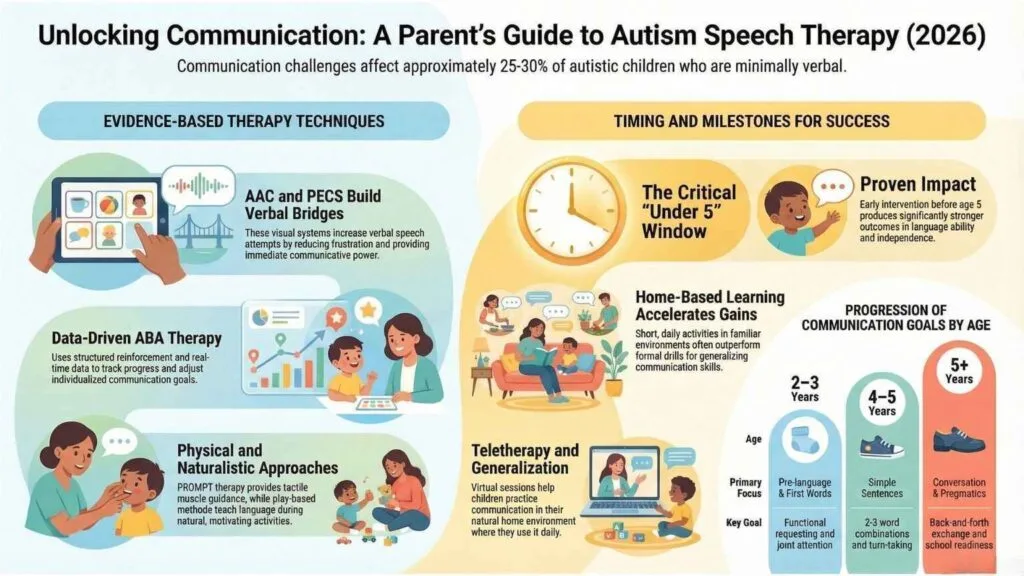
Communication goals in ABA therapy Virginia programs span a wide range of targets that reflect the diversity of where individuals with autism spectrum disorder are starting from and what communication gains will most directly improve their daily life. At one end of that range, initial functional communication training focuses on establishing a reliable way for a minimally verbal or non-speaking individual to make requests — using picture exchange systems, speech-generating devices, signs, or approximations of spoken words, depending on what the individual’s learning history and assessment indicate is most accessible.
For individuals who have some verbal communication but struggle with its functional use, goals shift toward expanding the communicative functions language serves — moving beyond requesting to commenting, asking questions, sharing information, and engaging in the back-and-forth exchange that social conversation requires. Pragmatic language development — understanding when to speak, how to adjust communication style for different listeners and contexts, and how to interpret the implied meaning in others’ communication — is a consistently important target for individuals whose literal language skills exceed their social communication application.
Augmentative and Alternative Communication
For individuals who are minimally verbal or non-speaking, augmentative and alternative communication systems — ranging from low-tech picture-based systems to high-tech speech-generating devices — are an evidence-based and often transformative component of the communication skills program that ABA therapy Virginia providers incorporate rather than treating as a separate domain. The evidence base for AAC is clear and consistent: providing an individual with a reliable communication system does not reduce motivation to develop spoken language — it increases it, by reducing the communication frustration that impedes language learning and by giving the individual successful communication experiences that build the motivation to communicate more.
Selecting the appropriate AAC system for a specific individual requires assessment of motor skills, cognitive level, learning history, and the communication environments the individual participates in — not a one-size-fits-all recommendation. Treatment planning that incorporates AAC selection and implementation alongside other communication skill targets produces more comprehensive communication support than treating AAC as an afterthought or a last resort.
Generalization — The Real Measure of Communication Success
The measure of successful communication skill development in ABA therapy isn’t whether an individual can perform a communication behavior in a therapy session — it’s whether they use that communication reliably and flexibly across the real environments and relationships that matter in their daily life. Generalization — the transfer of skills from the training context to the natural environment — is where many communication programs fall short and where the most clinically important work happens.
ABA communication programs that build generalization from the beginning — practicing communication skills with multiple people, in multiple settings, with varied materials and natural motivators — produce more robust and more durable communication than those that teach to criterion in a structured setting and then address generalization as a secondary step. Parent and caregiver training is an essential component of this generalization focus — families who understand how to support and reinforce communication skill use in everyday routines are extending the therapy into the hours of each day that aren’t covered by direct service.
Supporting Families Across Northern Virginia
For families in Northern Virginia, West Virginia, and Kentucky seeking ABA therapy that prioritizes communication skill development with the clinical depth and individualization that makes real differences in daily life, Positive Reinforcement provides services in-home, in community settings, and via telehealth — removing the geographic barriers that limit access to quality ABA services for families outside major metropolitan areas. Accepted insurance includes Tricare, United Healthcare, Cigna, Evernorth, Aetna, Medicaid, and Anthem.