Network Launches Free Peer Support Site for Veterans Two and Three Years After Service
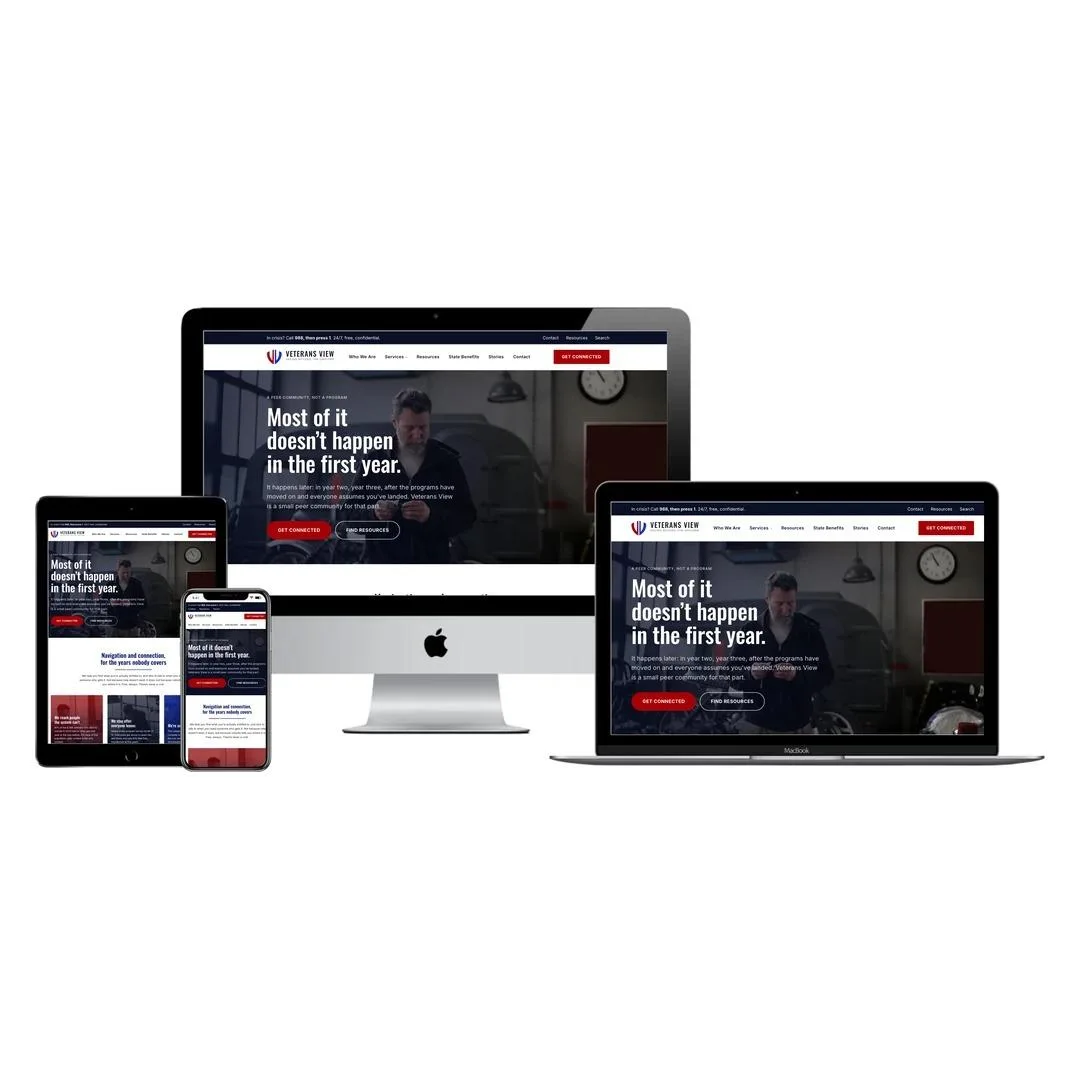
DENHAM SPRINGS, La., September 2, 2026. Veterans View Network, a peer support nonprofit for veterans in the years after service, has launched its website at veteransviewnetwork.org.
The organization serves a window most programs do not. Not the first ninety days after separation, when transition services are still engaged, but year two and year three, after the caseworker has moved on and everyone assumes the veteran has landed. The offer is deliberately narrow: help finding benefits a veteran is entitled to, and a connection to someone who has already been through it.
A Launch That Says What Is Not Ready
The site went live as a phased launch, and the phasing is visible to visitors rather than hidden from them. Pages that could be completed honestly were completed. Pages that depend on members who have not yet been interviewed are live, labeled, and intentionally empty.
The member stories page states plainly that its six story slots are still empty and that the quotes shown are placeholder text describing what belongs there. The events page lists the formats the organization intends to run and says none are currently scheduled. Member portraits are monogram tiles rather than stock photography.
“Putting a payment form in front of veterans before those are settled would be the exact behaviour this organisation exists to stand against,” said Nik Sanchez, founder of Veterans View Network.
The Guardrails Are on Every Page
Peer support sits adjacent to clinical care, and the site draws that boundary repeatedly rather than burying it in a footer disclaimer.
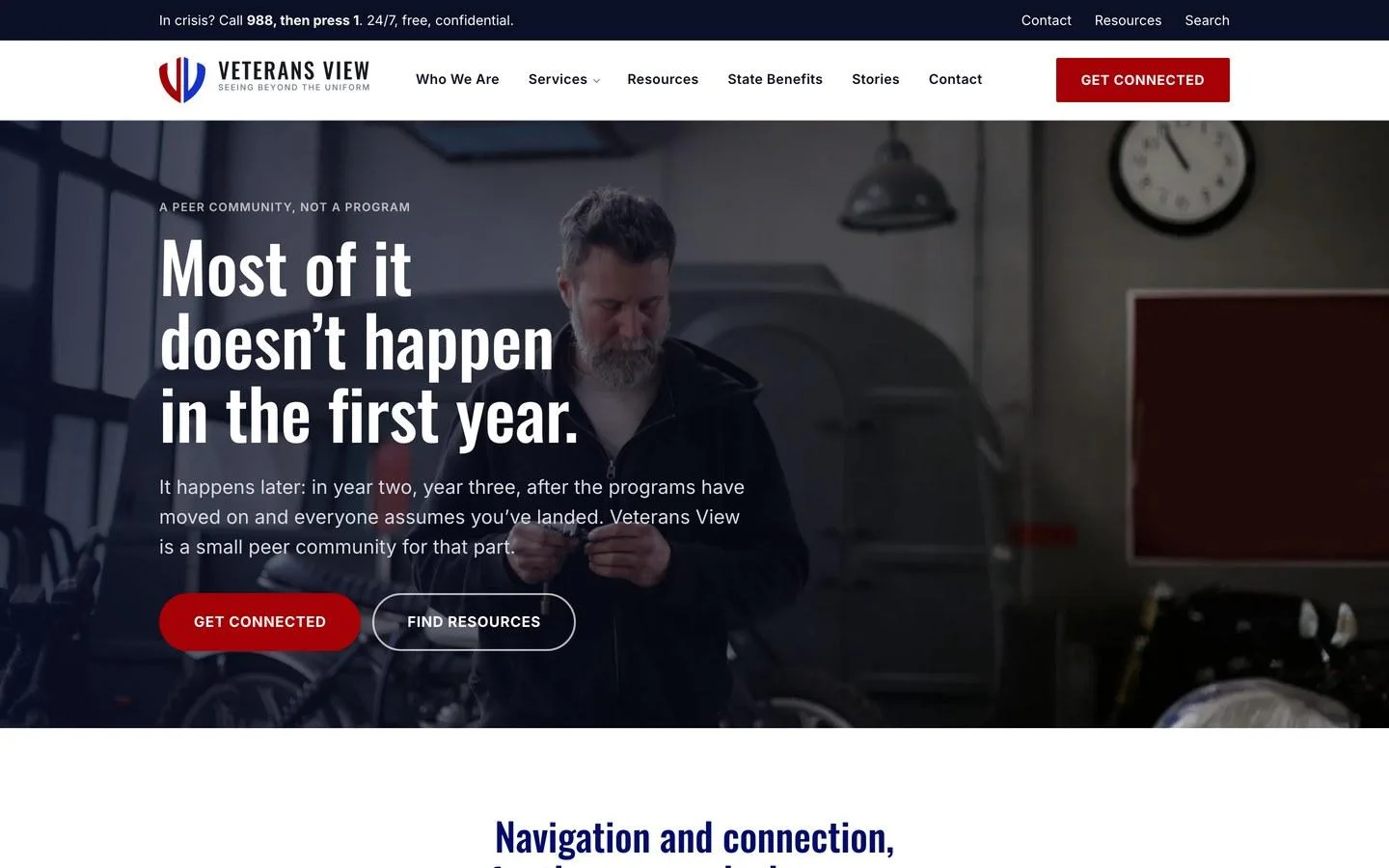
The copy states that peer support is not therapy and does not claim to prevent suicide, and commits to helping a veteran find clinical care when it is needed. A crisis line runs across the top of every page: call 988, then press 1. On the fee side, the organization does not file claims, promise disability ratings, or take a percentage of back pay; it points veterans to free filing through an accredited representative. There is no eligibility screen, and the intake form exists only to match a member with the right person.
No Donate Button, By Design
The support page carries no payment form. It explains that the entity type, registration status, and funding model are still open questions, and that a donate button will not appear until those are settled and published. It asks for time instead of money.
Measured Performance After Launch
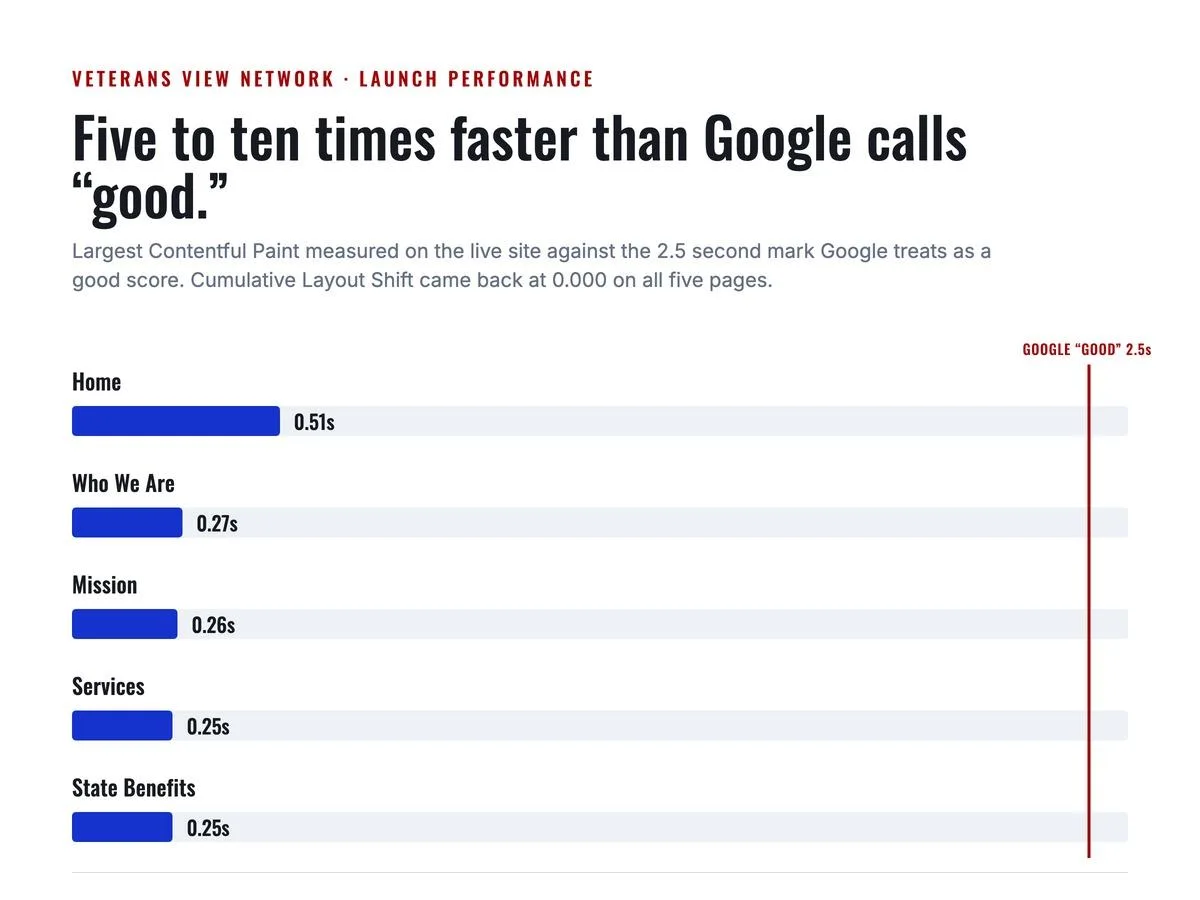
We measured page performance on the live site rather than using a plugin score. Largest Contentful Paint came in between 0.25 and 0.51 seconds across five pages, and Cumulative Layout Shift measured 0.000 on every one.
Google’s published guidance on Largest Contentful Paint treats 2.5 seconds or faster as a good score, putting the site between 4.9 and 10.1 times under that mark. Time to first byte measured around 140 milliseconds. The build is a static site with self-hosted fonts and no plugin stack.
The measurements were taken as the median of three cache-busted loads per page in headless Chromium at a 1440 by 900 viewport on September 2, 2026. They are lab measurements from a single fast connection, not Chrome UX Report field data.
A Benefits Reference Built From Primary Sources
The largest section of the site is a state-by-state benefits reference that links to official government sources rather than to intermediaries. No fee, no gate, and no form stands between a veteran and the link.
That structure deliberately responds to how the category usually works. Searches for state veteran benefits tend to surface lead capture forms dressed as guides, where the answer sits behind an email address and the visitor becomes a sales contact. Property tax exemptions, tuition waivers for dependents, hunting and fishing license provisions, and vehicle registration relief all vary by state, and a veteran who does not know a benefit exists has no way to ask for it.
Alongside the reference, the site organizes its work into three services: peer mentorship, benefits navigation, and claims support guidance. Each is described in plain terms, including what it does not cover. The claims page explicitly states that the organization does not file paperwork and instead points to accredited representatives, who file at no charge.
The build itself follows the same principle as the copy. Structure and research shipped complete, and the pieces that depend on real people were left visibly unfinished rather than staged. A Denham Springs studio designed and built the site; its nonprofit website design practice works the same way, and the approach is available to any organization willing to say what is true today.
About Veterans View Network
Veterans View Network is a peer support community for veterans in the years following separation, founded by Nik Sanchez, a Navy veteran with a background in administration, financial management, and organizational leadership. Services are free and include peer mentorship, benefits navigation, and claims support guidance. The organization is not a crisis service and does not provide clinical treatment. Veterans in crisis should call 988 and press 1. The organization is online at veteransviewnetwork.org.
Media contact: Clint Sanchez, Denham Springs, LA. clint@blaksheepcreative.com
###