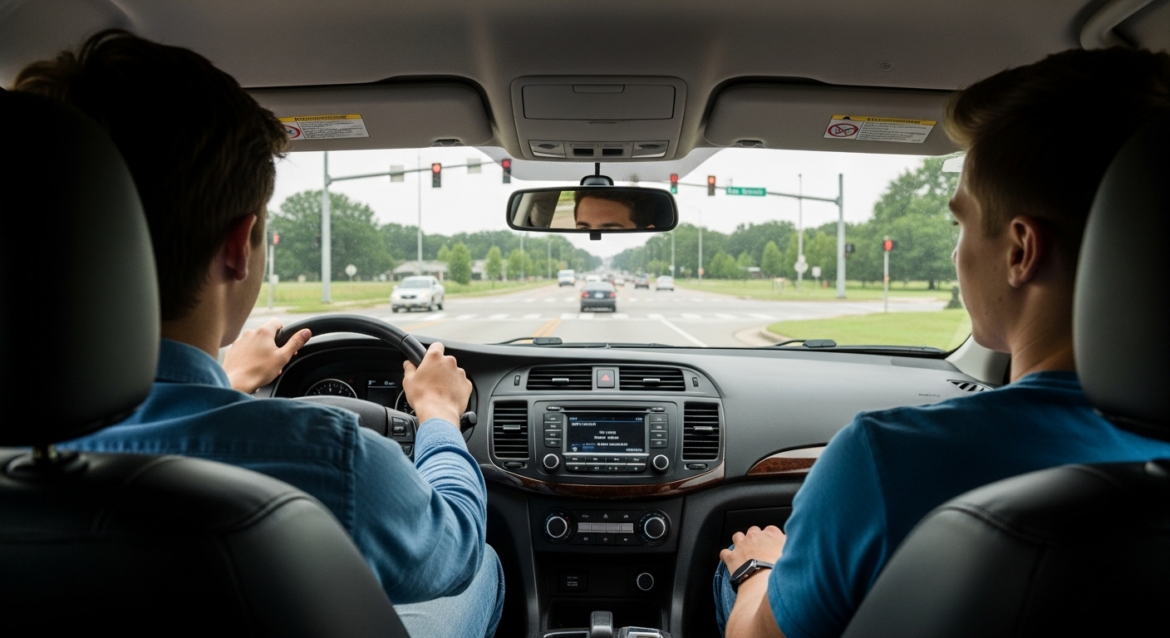
For most parents, the hardest part of teen driving is not signing up for instruction or helping a child prepare for a permit. It is deciding when that teen is actually ready for more independence. That decision rarely comes down to one moment. It is usually built from repeated observations, small improvements, and a growing sense that the teen can handle ordinary road situations without losing focus or becoming overwhelmed. In Baton Rouge, where traffic conditions can change quickly, and daily driving often involves busy intersections, school routes, and unpredictable flow, parents are right to look for more than basic technical skill. The real question is whether the teen is showing the judgment and steadiness that make trust behind the wheel more reasonable.
Why Parents Need a Practical Readiness Standard
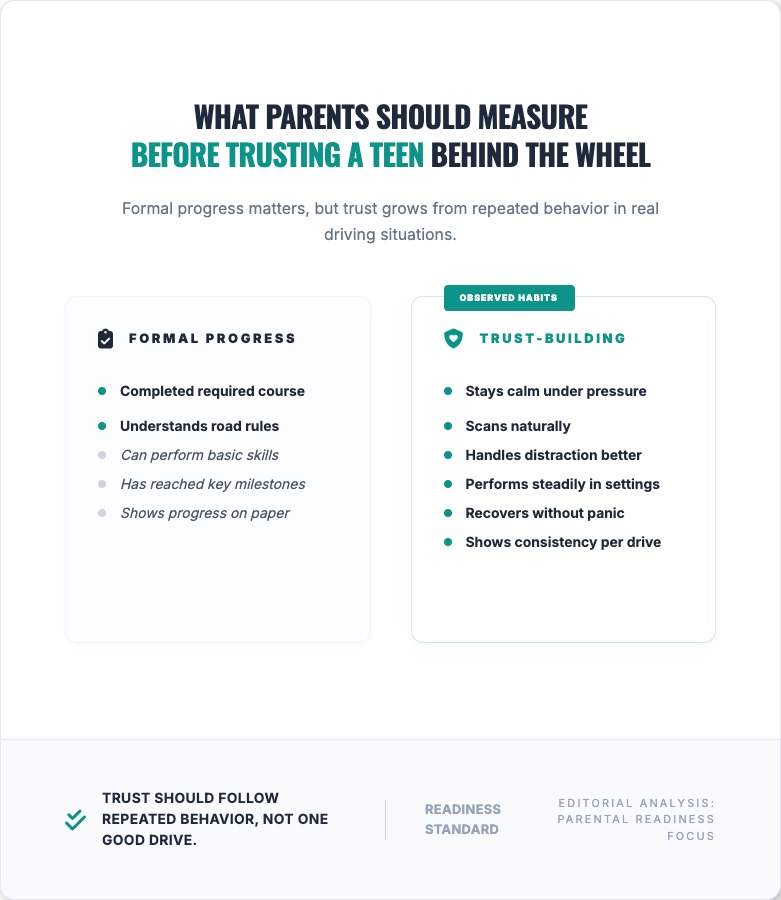
Many families assume readiness should be obvious once a teen has completed the required coursework or passed a key milestone. In practice, it is rarely that simple. A teen may understand the rules, drive well in familiar conditions, and still not be ready for greater independence and responsibility. This is why parents need a practical standard instead of a purely formal one. They need to watch what the teen does repeatedly, not just what the teen can do once under ideal circumstances.
A recent Baton Rouge-focused article, Why Teen Driver Readiness Is Becoming a Bigger Parent Concern in Baton Rouge, framed this concern as a readiness issue rather than a simple licensing issue. That local perspective matters because it reflects what many families already know from experience. The real decision is not whether a teen has entered the system correctly. It is whether the teen is beginning to behave like a driver who can handle real conditions with enough consistency to earn more trust.
Calm Decision-Making Matters More Than Parents Sometimes Expect
One of the clearest signs of readiness is calm decision-making. Parents should pay attention to how a teen responds when the road no longer feels easy. Does the teen rush when another driver is behind them? Do they hesitate so much that they create confusion? Do they react emotionally when something unexpected happens? Or do they stay composed enough to keep thinking clearly? Calmness matters because driving is full of ordinary moments that require quick but steady judgment.
That does not mean a teen should never feel nervous. Some nervousness is completely normal. The stronger sign is whether the teen can continue to function well despite that pressure. A calm driver is more likely to scan effectively, leave room for mistakes, and avoid turning one small surprise into a larger problem. Parents often recognize this trait intuitively. They can tell when the teen is still operating in a rushed or reactive way and when the teen is starting to settle into steadier habits.
Scanning Habits Reveal More Than Simple Steering Skill
Another important signal is whether scanning has become natural. A teen who only looks straight ahead may appear in control until the situation becomes more complex. Real readiness involves checking mirrors without constant prompting, watching cross traffic, anticipating what pedestrians or turning vehicles may do, and staying aware of what is happening beyond the car’s hood. These habits matter because they show whether the teen is beginning to process the road as an environment rather than just as a lane to follow.
Parents can often spot this by watching where a teen’s attention goes. A stronger young driver is not only reacting to what is directly in front of the vehicle. They are starting to read the bigger picture. That includes noticing brake lights sooner, adjusting to merging traffic more smoothly, and preparing for intersections before the moment becomes urgent. These are not dramatic skills, but they are the kind that make a real difference once a teen begins driving with less supervision.
Confidence in Low-Stakes Situations Should Come First
Before parents trust a teen with more difficult conditions, it helps to see strong consistency in lower-stakes settings. That includes neighborhoods, parking lots, basic route familiarity, and routine daytime trips. A teen who still feels rushed in these environments is not likely to become steadier simply by being given more freedom. Confidence should be built in stages. The goal is to see whether ordinary tasks begin to feel smoother before the teen takes on heavier traffic, nighttime conditions, or more distracting situations.
This kind of staged confidence matters because early success often creates the foundation for safer choices later. If the basics are still uneven, the parent is likely to be relying on hope rather than evidence. If the basics are becoming dependable, then expanding the teen’s range starts to make more sense. The question is not whether the teen wants more independence. It is whether the teen has shown enough control to handle it without a sharp drop in performance.
Parents Should Watch How Teens Handle Distraction Before Allowing More Freedom
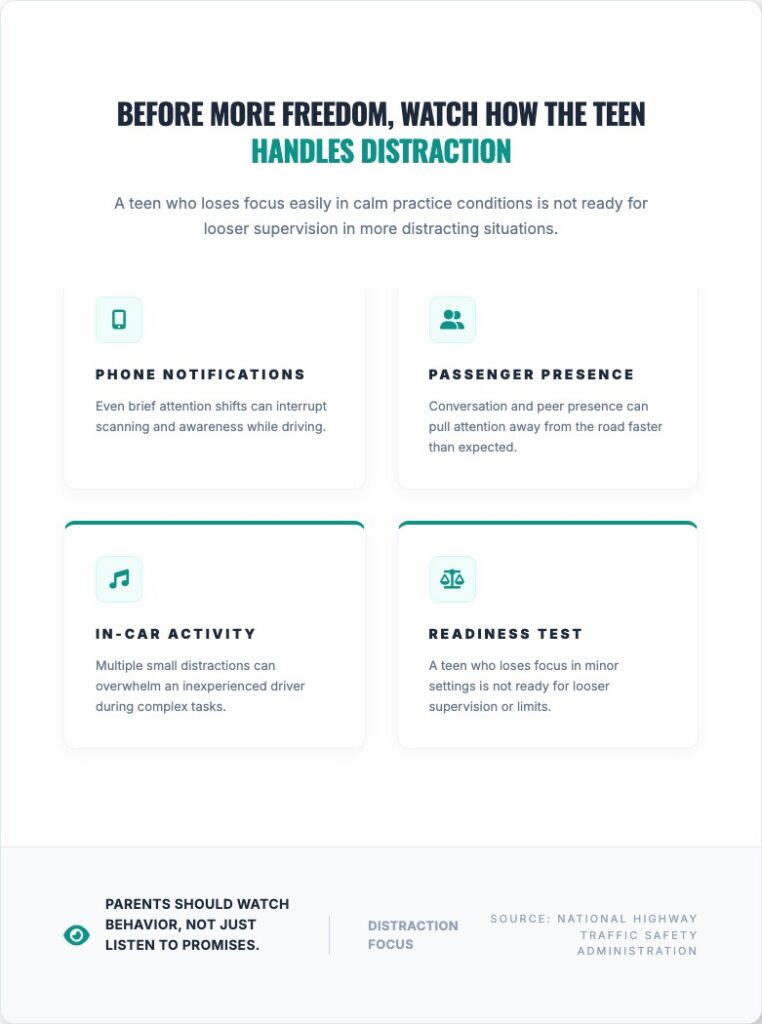
Distraction is one of the most important readiness tests because a teen rarely drives for long in a perfectly quiet environment. A phone notification, a conversation, a music choice, or an unexpected passenger comment can quickly shift attention. Parents should look closely at whether the teen stays engaged with the road when something else competes for attention. A young driver who loses focus easily with minor distractions is not ready for looser supervision, regardless of how well they perform in calm practice sessions.
The NHTSA guidance for parents of teen drivers emphasizes the importance of discussing distractions, passengers, and safe decision-making before teens gain more freedom behind the wheel. That advice matters because distraction is not just a bad habit. It is one of the clearest ways inexperience shows up once teens begin driving more independently. Parents who watch for this early are usually making a smarter readiness judgment.
Night Driving and More Complex Conditions Should Be Earned Gradually
Many parents already know that nighttime and more demanding roads feel different, even for adults. For teens, those conditions can reveal weaknesses that do not show up during daytime practice. Reduced visibility, more fatigue, glare, and less predictable driver behavior all make night driving a stronger test of real readiness. The same is true of heavier-traffic corridors, unfamiliar destinations, and situations where the teen has to make several decisions in quick succession.
This is why independence should usually expand in steps. A teen who has mastered calm daytime routes may still need more work before a parent feels comfortable with night driving or denser traffic. The Louisiana student and parent driver information page provides families with a structured guide to navigating teen driving requirements. However, parents still have to decide when practical readiness aligns with that legal pathway. In many households, the smartest approach is to slow the process down until the teen performs well across multiple types of conditions.
Jeremy Watson Says Consistency Is Often the Best Clue
Jeremy Watson, owner and lead instructor at Magnolia Driving Academy, says parents often benefit from focusing on consistency rather than a single impressive drive. A teen may have a good day behind the wheel and still not be ready for more independence if that performance falls apart in a different setting. From his perspective, stronger readiness usually shows up when a teen begins making better decisions without constant prompting, scans more naturally, and stays more composed when the road becomes less predictable.
That perspective gives parents a useful standard. Trust should grow when the teen’s behavior becomes more dependable, not simply when the teen feels eager or completes a required step. Readiness is less about a dramatic breakthrough and more about whether good habits are starting to hold together from one drive to the next.
Parents Should Trust Patterns, Not Just Promises
One of the biggest mistakes families can make is relying too heavily on what a teen says rather than on what the teen consistently shows. Many teens genuinely believe they are ready before their habits fully support that confidence. Parents are usually in a better position to evaluate the pattern. Are mistakes becoming less frequent? Is the teen recovering more calmly when something goes wrong? Are the same weak spots still showing up again and again? These patterns matter more than enthusiasm alone.
When parents focus on repeated behavior, the decision becomes more grounded. They are not guessing based on a single calm afternoon or a single successful lesson. They are looking at whether the teen is building a real track record of steadier driving. That is a much better basis for trust than a milestone by itself.
Conclusion
Before trusting a teen behind the wheel, Baton Rouge parents should be looking for more than completion, confidence, or excitement. They should be looking for calm decision-making, natural scanning habits, steadier performance in different settings, and a clear ability to handle distraction without losing control of the moment. Those are the signs that readiness is becoming real rather than theoretical. For families navigating this stage, the best test is not whether the teen wants more freedom. It is whether the teen is beginning to show the judgment that makes that freedom safer.