For many Baton Rouge families, the conversation about teen driving starts long before a road test. It begins when parents realize that getting a license and being ready to drive are not always the same thing. That gap is why teen driver readiness has become a bigger concern. Parents are not only asking whether their teen can pass the required course. They are asking whether their teen can stay calm in traffic, respond well to pressure, make sound decisions around distractions, and handle real road conditions without panicking. In other words, the concern is shifting from qualification to preparedness.
Why Readiness Feels Bigger Than the License Itself
In Louisiana, the formal path to teen driving is clearly structured. According to the Louisiana Office of Motor Vehicles student and parent information page, teens ages 15 to 17 complete a 38-hour driver education course that includes 30 hours of classroom instruction and 8 hours behind the wheel. That framework matters because it gives families a legal and instructional baseline. Still, parents often understand instinctively that minimum hours do not answer every question they have about real-world readiness. A teen may complete the required instruction and still need more practice in heavy traffic, neighborhood scanning, merging, nighttime driving, or managing anxiety behind the wheel.
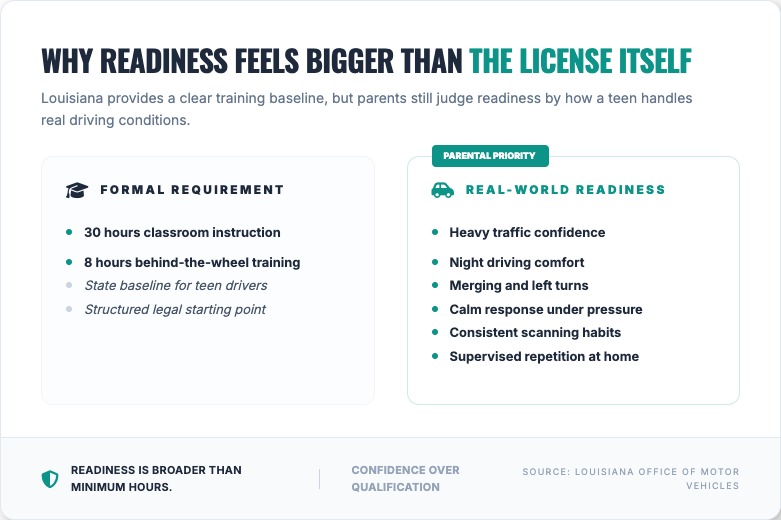
That is where the parent perspective becomes more serious. Families are not simply handing over keys because a course has ended. They are trying to judge whether their teen can apply what they learned when the road becomes less predictable. Baton Rouge makes that question feel especially practical. Parents are thinking about school commutes, left turns across busy roads, rain, traffic flow, and the split-second decisions that come with independent driving. For many households, readiness is not an abstract concept. It is the difference between supervised progress and premature freedom.
Why the Risk Picture Gets Parents’ Attention
National safety data gives parents a good reason to think beyond course completion. The CDC’s teen driver safety overview explains that drivers ages 16 to 19 have a much higher fatal crash rate than older drivers and that the earliest period of independent driving carries the greatest risk. Those facts do not mean every teen driver is unsafe. They do mean that inexperience is real, and parents are right to take the first stages of driving seriously.
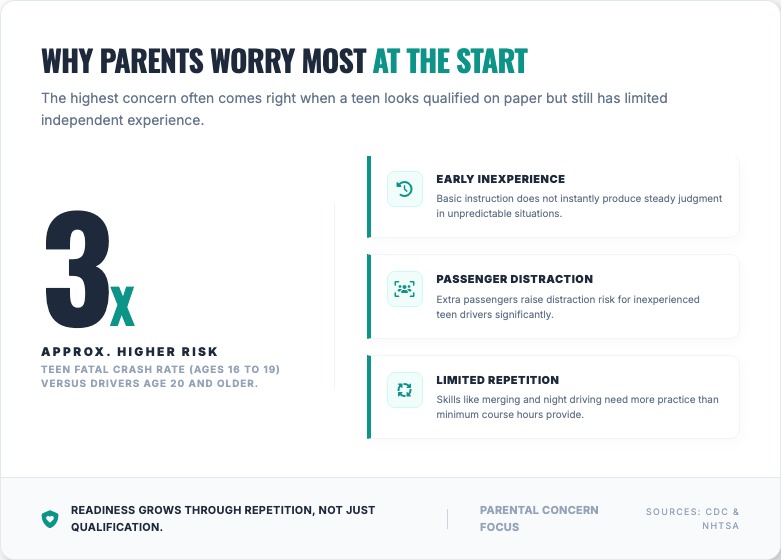
What often sharpens concern is the timing. Risk is not spread evenly across the teen driving years. It is concentrated in the earliest period, when a teen has basic instruction but limited independent experience. Parents tend to feel that intuitively. They know their child may understand rules in theory while still needing more repetition before reactions become steady and judgment becomes more reliable. That is why so many parents worry most at the exact moment their teen begins to seem qualified on paper.
What Readiness Actually Looks Like in Practice
Driver readiness is broader than technical skill. It includes awareness, emotional control, consistency, and the ability to process multiple things at once. A teen may know how to steer, brake, and follow signs, but readiness also means scanning intersections, anticipating what other drivers may do, and staying composed when something unexpected happens. These are the kinds of habits that usually improve through repeated practice in different settings rather than through one milestone alone.
For parents, that can be hard to measure because progress is rarely dramatic. What usually changes is subtler. The teen becomes smoother in turns. Parking becomes less rushed. The driver starts checking mirrors more naturally. Traffic lights, lane changes, and stop-and-go flow begin to look less overwhelming. Parents tend to notice these shifts over time, which is why readiness often feels like a judgment call rather than a clean cutoff. The teen may be improving steadily while still not quite being ready for full independence.
Why Parent Involvement Still Matters After Driver’s Ed
One of the strongest themes in teen driving safety is that parents remain central even after formal instruction begins or ends. The state gives families a framework, but the household usually provides the repetition that turns instruction into confidence. Parents decide how much supervised driving occurs, which conditions take precedence, when nighttime practice is introduced, and what rules apply once the teen begins driving more independently. In that sense, readiness is built at home as much as it is taught in a course.
That is one reason Baton Rouge parents increasingly want more guidance rather than less. They are trying to understand how to assess progress without rushing, how to build confidence without creating overconfidence, and how to set expectations that align with their teen’s actual maturity behind the wheel. A structured course helps, but family involvement is what usually determines whether a teen builds enough repetition to handle common but stressful situations with better judgment.
What Jeremy Watson Says Families Often Miss
Jeremy Watson, owner and lead instructor at Magnolia Driving Academy, says many families naturally focus on the licensing milestone because it is visible and easy to track. But from his perspective, readiness is usually more about what happens between lessons and after them. He points to confidence, hazard awareness, steady scanning habits, and calm decision-making as signs that matter just as much as the ability to complete the formal process. Parents often notice those traits developing gradually, which is why the readiness conversation tends to stay active even when a teen is technically moving through the required steps.
That perspective reflects a common parent experience. Families may realize that their teen seems capable in one setting and uncertain in another. A student who does fine on neighborhood roads may still need more work in denser traffic. A teen who handles daytime driving well may not yet feel ready after dark or with added distractions. Readiness is therefore less about one pass-fail moment and more about whether performance stays consistent across the kinds of situations the teen will actually face.
Why Structured Education Still Plays an Important Role
Even though readiness goes beyond minimum requirements, structured instruction still matters because it gives families a better starting point. Formal education introduces core road rules, supervised skill development, and a more consistent learning environment. For many parents, that structure makes the next phase easier because they are not starting from zero. They are building on a foundation. A local example appears in this teen driver education program for Baton Rouge families, which reflects the kind of structured training families often look for when they want a teen to begin with instruction rather than trial and error.
The stronger point is not that a course solves everything. Good instruction can help families move from general worry to more specific, manageable next steps. Once a teen has a structured learning base, parents can better identify where extra practice is needed and where confidence is growing more realistically.
Why Baton Rouge Parents Are Thinking More Carefully About the First Solo Drives
The first months of teen driving tend to carry more emotional weight for parents because that is when responsibility starts shifting from the adult to the teen. Even in households that are excited about the milestone, the transition can feel uneasy. Parents know their child is gaining independence, but they also know that inexperience does not disappear the day a permit or license requirement is met. That tension is exactly why readiness has become such an important concern. Parents are trying to balance trust with caution in a phase where both are necessary.
In Baton Rouge, where traffic patterns and daily driving demands can change quickly depending on time of day and location, that balancing act feels especially real. Parents are often not looking for perfection. They are looking for enough maturity, repetition, and steadiness to believe their teen can handle common road situations without becoming overwhelmed. That is a much more practical standard than simply asking whether the teen finished the course.
Conclusion
Teen driver readiness is becoming a growing concern for parents in Baton Rouge because families increasingly understand that a license pathway and real preparedness are not the same. Louisiana’s driver education requirements provide an important foundation, but parents still have to judge how well a teen can turn instruction into safe, consistent behavior on the road. That is why the readiness question matters so much. It is not only about passing. It is about whether a young driver is prepared to handle independence with the judgment, confidence, and attention that real driving demands.